Students and educators grapple with a post-Clavicular world

By Julian Sharma
Classrooms across the country are spaces meant for growth and learning. Educators strive to make students feel welcome and understood. While oftentimes underfunded, they work hard to ensure environments where every student is safe and heard.
In recent years, controlling the sanctity of that environment has become increasingly difficult to manage. As the digital world continues to slip through the cracks of our physical lives, educators are facing extreme manifestations of misogyny and sexism in everyday classroom settings. Students, particularly girls, are now left to bear the brunt of the consequences.
A new report detailing research done by White Ribbon and Angus Reid illustrates how online misogyny influences young boys and men in Canada, detailing concerns that have risen due to its presence in classrooms.
“Hateful ideologies that are being promoted online are increasingly being transported into real-life situations that are impacting how youth are engaging with one another,” says Humberto Carolo, Executive Director at White Ribbon. “They’re leading to gender-based violence, harassment and discrimination in real life.”
Statistics from the press release demonstrate that 95 per cent of educators say boys and young men are exposed to sexist and misogynistic ideologies online. Four in five educators have witnessed misogynistic behaviours in classrooms, including unhealthy stereotypes, disrespect towards women and aggression.
A study by researchers Emelia Sandau and Luc Cousineau at Dalhousie University shows examples of this behaviour, citing the experiences of one teacher who said the boys in their classroom have taken to calling women and girls “holes.”
Lexa Perl, a teacher at East Marriott Secondary School in Surrey, B.C., has experienced some of this firsthand.
“On a number of levels, I don’t think they particularly respect me as a human being,” Perl says. “And I think that is tied up in, obviously, misogyny, and then transmisogyny and transphobia on top of that.”
Perl is a trans woman. She mentions that before she transitioned, she noticed that it was more likely for her students, particularly the younger boys, to listen to her. Presenting as masculine meant it was easier for her to gain their respect, an indication of how these boys are treating the women and gender minorities in their lives.
Teachers are doing what they can to alleviate the issue. A method Perl uses to try to offset a problem before it arrives is setting boundaries at the beginning of the school year. She outlines what she will and will not tolerate in her classroom and lets students know the consequences of disrespectful behaviour.
But the responsibility can’t all be on the teachers, who are already stretched thin. Perl says parents need to monitor their children more closely and remain aware of what their children are doing online. Teachers do not have the capacity to observe the online activity of every student in their classrooms.
“We just have so much that we have to deal with, that the issue of misogyny in schools and in our workplaces as teachers is kind of the least of our worries sometimes,” says Perl.
Solutions to this issue are complex, as are the ways to execute them. Governments, such as British Columbia’s provincial government, have introduced cell phone policies that restrict the use of personal digital devices in schools. While this seems like an easy fix, the reality is much more complicated for teachers to implement.
Teachers have adapted learning methods to include the use of digital devices like laptops or phones. If phones are meant to be restricted in classrooms, then they must rely on students having access to laptops. However, Perl explains that funding issues in many schools make it difficult for them to provide laptops to all students, so oftentimes she will have to ask students to get out their phones for an activity, making it hard to reinforce restrictions set in place by the government.
“On a number of levels, I don’t think they particularly respect me as a human being”
School administrators must also work to support teachers when they come forward with problems. “I think we failed to listen to teachers for a really long time about this,” says Sandau in a joint interview with co-author Cousineau.
Perl recalls a lack of follow-through from her school board when reports were made about misogynistic behaviour. Additionally, in past years, she observed a ‘boys will be boys’ attitude in response to their misogyny. Administrators and teachers alike don’t always have the capacity to handle every report that comes their way, which makes it difficult to see real change.
The prominence of misogynistic ideology in educational spaces indicates its grasp on the rest of the world.
“It’s not just going to stay isolated inside the vacuum of K to 12 education,” says Sandau. “It’s going to ripple out into our society more broadly.”
Sandau emphasizes that educators and students are facing a very real threat of gender-based violence. While the threat is not new, it is expanding. The amplification of the issue can be attributed to the “manosphere,” an online movement of influencers who promote harmful ideologies surrounding masculinity. Andrew Tate is an example of one of these influencers, promoting misogynistic messages with millions of followers on social media. He is facing charges of rape, trafficking and actual bodily harm in Britain, as well as allegations of rape and trafficking in Romania.
Due to Tate’s prominence on social media, boys and men are able to follow and consume his content with seemingly no restrictions. That kind of access to harmful messaging is what leads to issues like the one arising in classrooms, where boys are repeating the rhetoric they’re internalizing without caring about the harms.
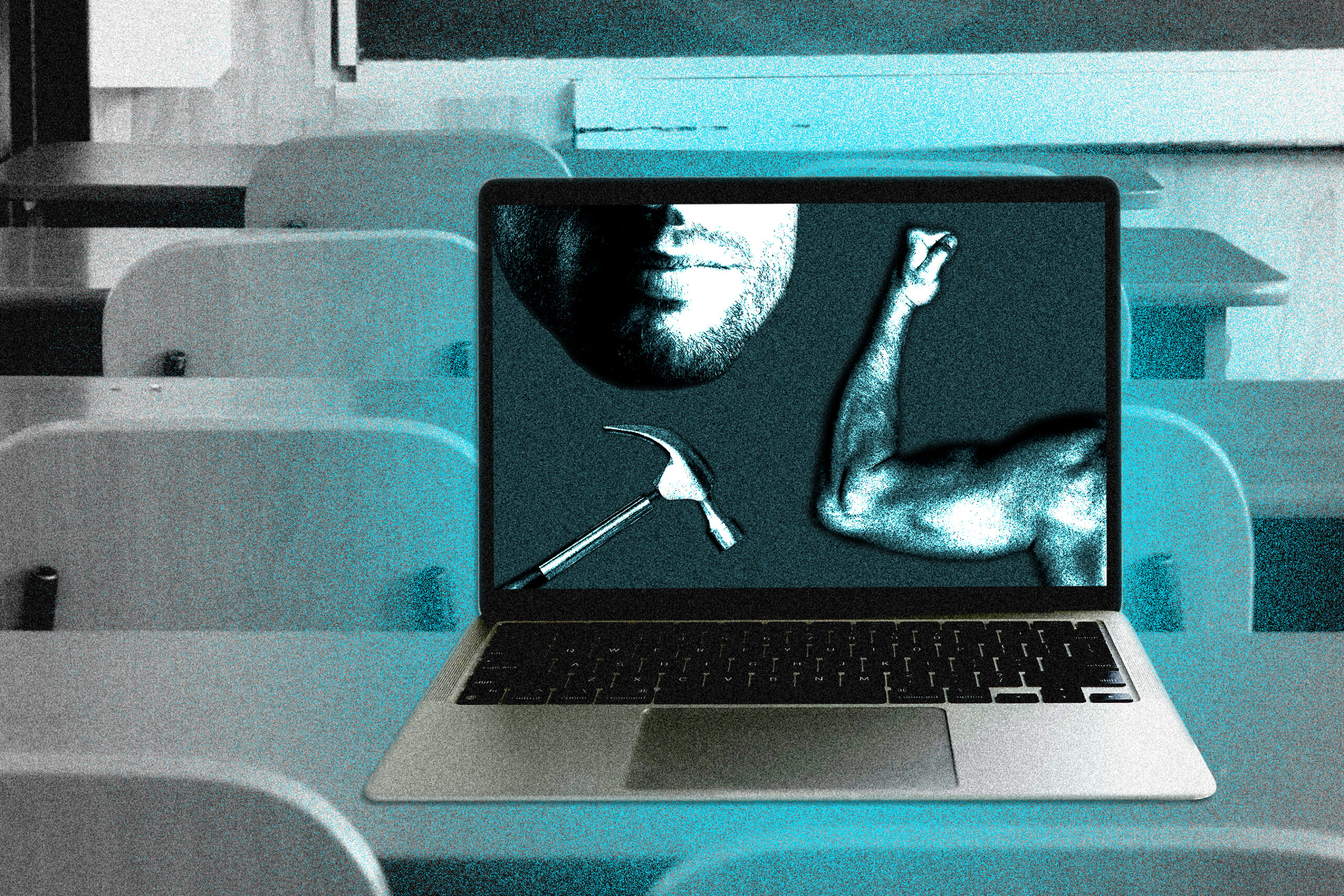
More recently, a 20-year-old man named Braden Peters, contemporarily known as “Clavicular,” has become the new face of a primarily male internet subculture called “looksmaxxing.” Looksmaxxing started on misogynistic online forums in the 2010s as an ideology that places looks above all else, believing it to determine things like how much money you make and who you date. It gained popularity in the 2020s on TikTok and has begun to reach the same boys who are engaging with and consuming manosphere content.
Peters is also a streamer who has taken testosterone, steroids and even illicit substances to reduce his appetite. He’s an example of how far the looksmaxxing movement extends and how it can affect those victim to it. While the culture is targeted towards men, the misogynistic implications remain. The New York Times’ profile on Clavicular suggests that women are the reason the looksmaxxing movement exists, a perspective that is strengthened by its origins in incel spaces.
For White Ribbon’s Carolo, the role of social media platforms in society has resulted in this surge of online hate, misogyny and homophobia. Social media influencers in particular are leveraging these platforms to promote hateful ideologies and misogynistic content.
In Australia, the government has made efforts to combat the harmful usage of social media platforms. A social media ban for those under 16 went into effect on Dec. 10, 2025, after a study conducted that year found 96 per cent of children aged 10 to 15 used social media and that seven out of 10 had been exposed to harmful content. It is the first policy of its kind and its effects remain to be seen, as kids state their lives haven’t changed substantially since the ban.
Jillian Sunderland, a PhD candidate at the University of Toronto whose research specializes in masculinities across media and state, says that the consequences of the rise of hateful behaviour are already present in our world. As a result, society broadly is now facing the diffusion of misogyny.
Article co-author Cousineau cites events such as the overturning of Roe v. Wade in the United States as an example of that diffusion. If the issues being discussed now regarding misogyny in our society are not properly addressed, things have the potential to get worse. Boys in primary and post-secondary classrooms will continue to perpetuate harmful language and actions with no repercussions or education on why they should not internalize those messages. That absorption could go on to affect their interpersonal relationships and the lives of the people around them.
“It’s important not to forget, like, this isn’t just a problem for today or a problem for how it ripples out today or in the next two years,” says Cousineau. “It’s potentially a problem 10, 15 and 20 years from now.”
White Ribbon’s report ends with a call to action, urging governments, educators and communities to enact solutions to stop this crisis before it worsens.
Education is the first step to resolving a crisis such as this one. Relying on teachers entirely isn’t the solution, but working to make sure they get the resources they need to help the kids who need it might be. Change is still possible, but it requires the efforts and collaboration from people at all levels — from parents to those sitting on boards of education across the country — in order to make it happen.