
Canadian author and CBC Literary Award winner explores the realities of sex work, street life and survival

By Ra’eesa Baksh
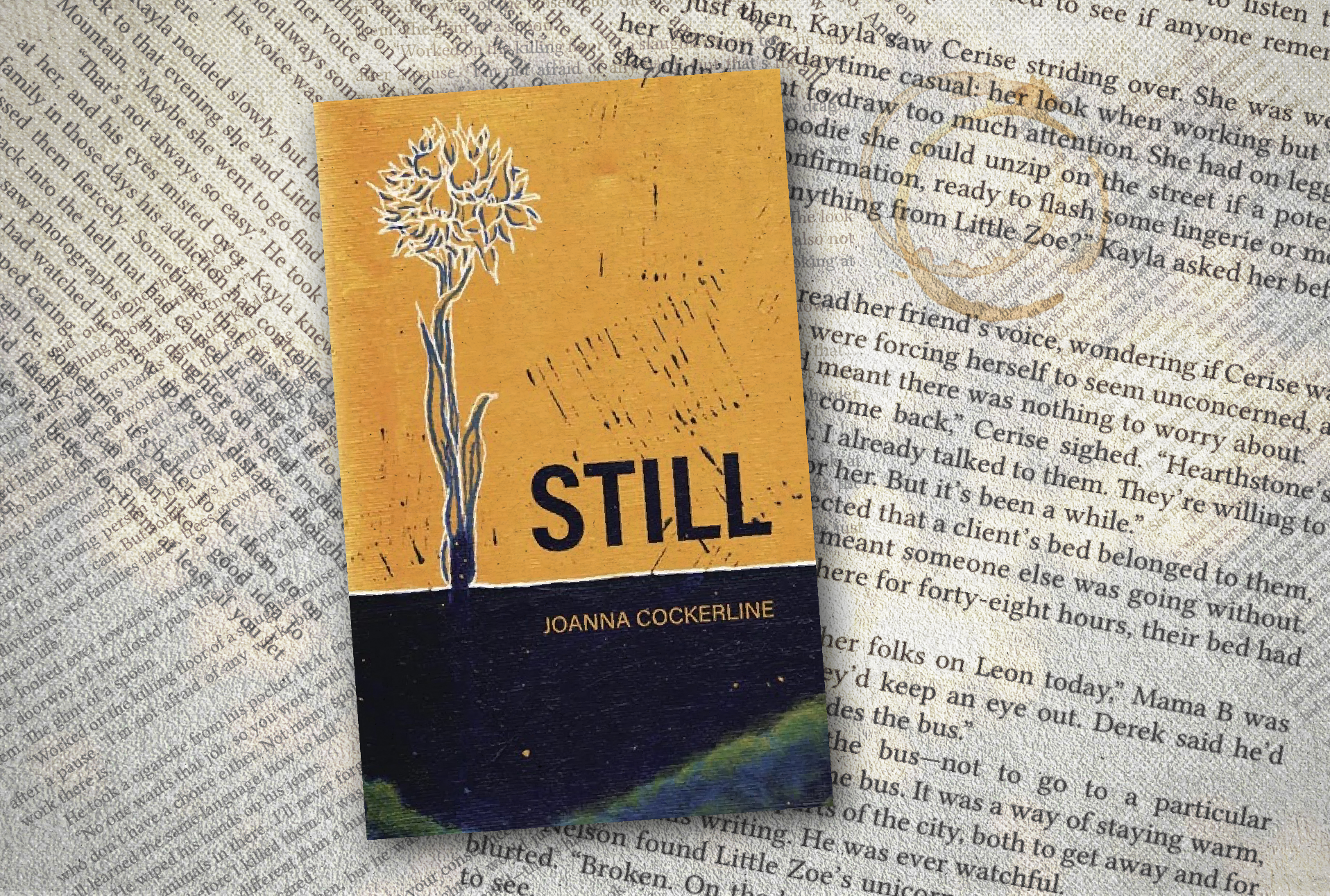
Joanna Cockerline’s novel Still follows the stories of unhoused people in Kelowna, B.C. The author, having worked eight years in street outreach, draws inspiration from her observations of community resilience and hope. She explores ideas of memory and trauma through Still’s focus on the realities of sex work and street life survival.
Against the backdrop of the Okanagan Valley, Cockerline explores experiences of loss, overdose, abuse and disappearance, all on top of a struggle for survival.
Still revolves around a young sex worker, Kayla, who is on the run from a traumatic past and becomes unhoused.
The novel is an immersion into the realities of sex work and street life for the unhoused population and survival techniques based in community. Cockerline’s lived experience is one that embodies resilience, hope, and friendship. In an interview with CanCulture, she said her writing is a blend of experiences: her own, of friends and all the people she has met.
“They’re all conglomerates and imagination and a kind of rich collection of a bunch of experiences stemming back for many years,” said Cockerline.
“I wanted to face them head-on in a way that was realistic and not romanticizing anything. I wanted to address serious issues that matter and should be talked about,” said Cockerline. “I wanted to humanize, peel back the stigmas, peel back the layers and see people as people, and that meant involving heavy issues.”
Having moved to B.C. from Ontario, she felt that writing Still without honouring the presence of the Syilx people of the Okanagan Nation — in addition to acknowledging all the missing and murdered Indigenous women in Canada — would be unjust, especially with Kayla using the environment and her love of animals to heal her traumatic past.
Cockerline writes about the Syilx people by embodying their values and personalities into her character Gloria, a spearhead and struggling community member looking out for others.
In her own time, Cockerline has taken Syilx cultural lessons and has actively consulted with knowledge keepers, elders and language teachers.
“I wanted to really write about a place and the only way to accurately and honourably write about [Kelowna] is to write about the Syilx people,” said Cockerline.
Cockerline said she has been heavily influenced by the land and that her worldview has widened from it. She wants to share that despite struggle, there is care in friendships, compassion and empathy. In conversation, Cockerline extensively highlighted the importance of reconciliation efforts with Indigenous communities and of municipalities working through and supporting the community.
Still makes use of flashbacks to tell Kayla’s life in full. In discussing who Kayla had become to Cockerline over the course of writing the novel, she explained that their relationship was one that was years in the making, as she feels she has carried a part of Kayla with her for some time now.
“Kayla has been brewing as a character for many years, long before this book got written, so I feel like I’ve really come to know her. I wanted to explore in this book her capacity for growth as well as working through memory and trauma and really becoming who she is,” said Cockerline.
Cockerline became so attached to Kayla’s character that she’s writing a sequel to Still that will see Kayla’s story continue.
“She is definitely focused on survival in the first book and in the second, we see a shift from mere survival to really living and building the capacity to experience joy and growth.”
Cockerline’s ability to draw Kayla’s story into something personal is admirable, as there is real love and craftsmanship in her story. She hopes to spark inner reflection and solidarity in readers. When visiting her friends in the unhoused community during street outreach, Cockerline recalled they were happy for her about the release of Still and demonstrated support by getting copies themselves. She hopes that more municipalities will build on their community services.
“I think the city of Kelowna is doing a good job with needs-based housing and I think needs-based housing is connected to community services that don’t infantilize and pathologize individuals but instead are built on a cycle of empowerment,” said Cockerline.
Currently, the city of Kelowna is running an embedded community program that allows community members to gain casual work experience and access to mentorship, volunteering, community and employment opportunities.
Cockerline believes that sex work should be decriminalized so that sex workers can control their working conditions, “rather than cultivating notions of victimhood or pathologization.”
Still encourages readers to stand in solidarity, empathy and compassion with their vulnerable neighbours. Cockerline peels back those layers from eight years of street outreach; she is ready to continue writing about a community bonded by resilience and hope.
You can find a copy of Still at your local bookstore!

Leave a Reply