
A Market Gallery exhibit explores how the meaning of home transforms across time and communities

By Liana Yadav
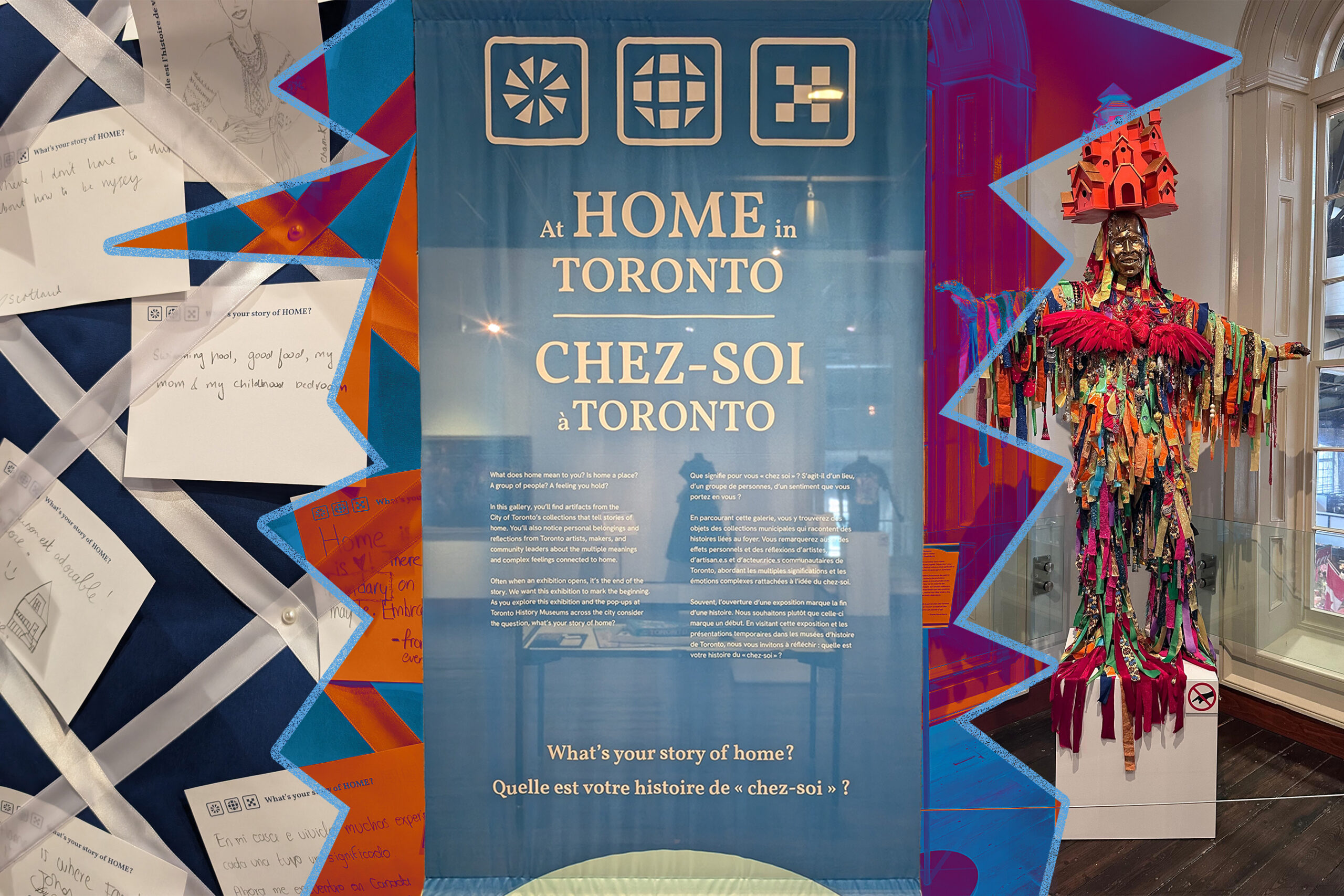
What’s your story of home?
That is the question that “At Home in Toronto” sought out to answer in its Market Gallery exhibit. Located in the heart of the St. Lawrence Market in what used to be Toronto’s first purpose-built City Council Chambers, the exhibit lived at the gallery from June 27 to Nov. 30. It housed historical and contemporary artifacts from the city’s rich collection, displaying different renditions of what people throughout Toronto’s history have considered home.
The Ward (2016)

“The Ward” by Luis Jacob.
Luis Jacob’s eponymously named piece displayed an aerial view of “The Ward,” Toronto’s first immigrant neighborhood which housed emancipated Black Canadians, along with the first generations of Irish, Jewish, Italian and Chinese immigrants. The empty white space in the centre represents the homes that were cleared out a century later to allow for the construction of Toronto City Hall.
Home Safe Toronto (2009)
Capturing Toronto’s tensions as well as its beauty, a TV played snippets from Laura Sky’s documentary Home Safe Toronto from 2009, which looked at houselessness through children’s perspectives. Sky uses their heartbroken confusion and hopeful determination to encourage more empathetic dialogue about the crisis.
On social media, the conversations surrounding unhoused people are usually that of blame, spite and even disgust. But becoming unhoused isn’t self-inflicted — it is a result of one’s material conditions and systems abandoning them. The city-wide survey Street Needs Assessment in 2024 recorded around 15,400 people to be experiencing houselessness in the fall of 2024 compared to about 7,300 in April 2021. The most identified reasons include lack of income, domestic conflicts, mental health issues and unsafe homes which are exacerbated by COVID.
Parliament Street Dance (1939)

“Parliament Street Dance” by Frederick Hagan.
Painted by acclaimed Toronto artist Frederick Hagan using oil on cotton, “Parliament Street Dance” depicts the bustling streets of Cabbagetown from the 1930s. At the time, the neighborhood was one of the city’s more impoverished areas, yet Hagan chose to represent the high spirits of its people in his art, showing them dancing and embracing each other. This painting reminded me of how resilience can come in the form of community even with a lack of resources.
Photograph of Michelle DuBarry (2007)

Michelle DuBarry as Grand Marshall of 2007 Pride.
Home is where you find chosen family and friends. Hung on the wall was a photograph of Michelle DuBarry, who has been doing drag since the 1950s. At the time, DuBarry benefitted from The 519’s support services for queer community members.
The 519 is a community centre that has served members of the 2SLGBTQ+ community in Toronto since 1975. It has been a place of refuge for countless people and continues to advocate for the city’s queer populous today.
Junkanoo

“Junkanoo” sculpture by Frantz Brent-Harris.
Frantz Brent-Harris’ sculpture “Junkanoo” models the celebration of the Jamaican festival that was an important form of resistance for enslaved people. They would use their only day of reprieve to engage in this powerful and artistic form of protest. In his artist statement, Brent-Harris describes how his Jamaican ancestors preserved their traditions and celebrations even in such tumultuous times. Each piece of cloth in this artifact was vivid in its colour and detail, inviting you to look at it longer and reflect on its significance.
All I want is to sweeten your tea (2003)

“All I want is to sweeten your tea” by Natalie Wood.
In a painting, Trinidadian-Canadian artist Natalie Wood represented the story of Mary Louisa Pipkin, a Black woman who fled to Toronto via the Underground Railroad in the mid-1800s. She became a laundress to the rich Austin family who owned the Spadina House. Wood sprinkled the words “molasses” and “honey” against a portrait of Pipkin holding a cup and named it, “All I want is to sweeten your tea,” representing Wood’s desire to alleviate the struggles of Pipkin’s difficult life. This painting conveys the power of art in telling the stories of those that history overlooks.
Safekeeping memories on paper
My favourite section of the exhibit was “Safekeeping memories on paper.” What struck me was the simplicity of these artifacts: a ticket stub with Toronto as its destination from 1919, penciled with the words “I’m coming home”; a diary entry by an immigrant from the 1890s about feeling isolated after losing his family; a concert programme of gospel singer Mahalia Jackson performing in Massey Hall in 1956. Each felt like a reminder of how past lives mirror the people in our city today. Our emotions and the depth with which we feel them remains the same, no matter years of modernity.
Like Water No. 10 Humber River Falls (1996)

“Like Water No. 10 Humber River Falls,” by Doug Brown.
Towards the end of the exhibition, another black and white print caught my attention. “Like Water No. 10 Humber River Falls” by Doug Brown called out how home is “not a fixed location, but a state of flow—a way of moving with change rather than against it.” Brown compares creativity to a river. Both, despite facing a shift in their foundation, “find new paths when old ones are blocked.”
Even as we navigate scary political realities — bureaucratic leaders passing bills that threaten our autonomy and undo years of progress — we find strength to renew, create and to keep flowing like the lakes that surround our city. This print looked simple from a distance, but up close I noticed every stroke was different in its thickness and bends, each block forming a unique part of the whole image. This bears much similarity to our city — everyone’s story is different, yet forms the complete landscape that is Toronto.
A canoe in troubled waters (1958-1960)

“A canoe in troubled waters” by Chief Matthew Bernard of Pikwàkanagàn First Nation, Golden Lake, Ontario.
“At Home in Toronto” serves as a reminder that Toronto’s history is the foundation on which we must rest our future. “A canoe in troubled waters” presented a model of a canoe created by Chief Matthew Bernard of Pikwàkanagàn First Nation, asking how we might look at our home if we strived to be better guests as settlers. Made with birchbark, hide and resin, the artifact is an ode to Indigenous conservation, sustainability and sovereignty.
The exhibit asked the viewer to grapple with an important question: what is your vision for the future of home and how can you make it a reality? Despite its cultural, social and emotional significance for so many communities, people in the city continue to face challenges as a result of broken systems plagued by profit-seekers. From inequitable housing and a cost of living crisis, Toronto has not been welcoming to everyone who calls it home or came here looking for one.

For me, Toronto has been home through my adult life. I moved here at 19 as an international student, completely unaware of the ways my life was going to change. This city has been kind to me, even when some of its people haven’t. And on the days the city felt cold and alien, its people have lent out a helping hand.
I feel conflicted about which place to call home. Delhi, the city I grew up in where I find magic in every corner, or Toronto, the city that has shaped me into who I am today? I’m torn but in a way, I also feel like a piece of me belongs to both cities. I am lucky to get to call two places home and to have found people who love me in both.
To remind myself of home and the person I left behind there, who I like to believe I still inhabit whenever I go back, I carry a mandala I made as a kid which my mom hung up proudly in her living room. I never saw the beauty in it. Today, I have it framed in my room where I allow myself to feel the pride that she did. It is a piece of my mom’s love. It is a piece of home.

Leave a Reply